
Surviving Difficult Meetings: What One Brutal Experience Taught Me
There are meetings that test you. Then there are meetings that stay with you for years.
This is about one of those.
Day One. A Room I Wasn’t Ready For.
I had just started a new job. I didn’t know my colleagues yet. I didn’t know the project. I didn’t know the politics. And within what felt like minutes of arriving, I was sitting in a meeting room with two people I had never met — a Project Manager and his Team Leader — with absolutely no context for what I was walking into.
I wasn’t the one being evaluated. But what unfolded over the next 45 minutes — though it felt considerably longer — is something I have never forgotten.
The First Signal Was a Pen Mark
Before a single word was spoken, something small told me everything I needed to know about the dynamic in that room.
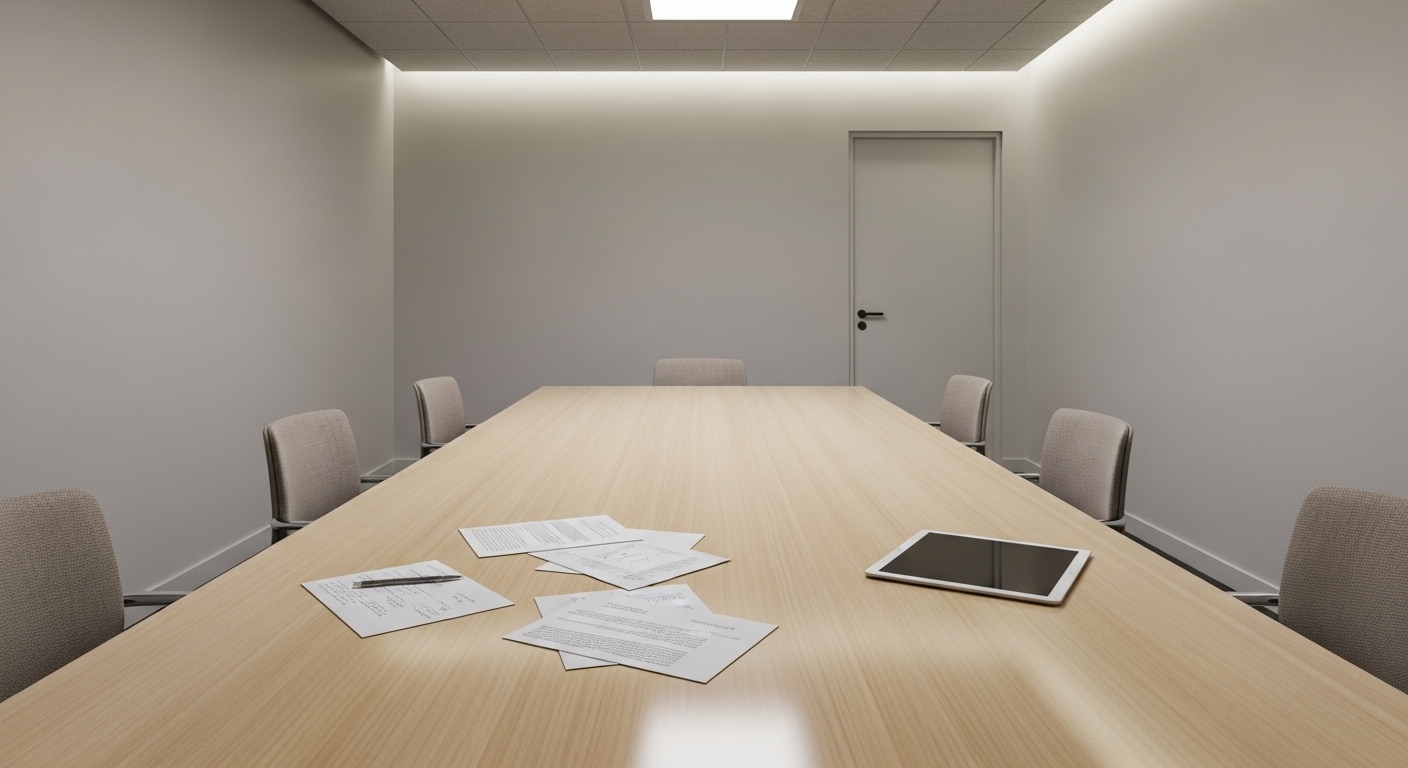
There was a printed PowerPoint deck on the table. A project status presentation. The Team Leader’s name was on the cover — professionally formatted, clearly the original author. Underneath it, added in pen, was the Project Manager’s name.
Not typed. Not formatted. Written in biro, underneath hers.
That one detail — that small, almost throwaway thing — told me immediately that this was not a partnership. This was not a handover. This was something else entirely. The PM had added his name to a document he hadn’t created, to a project he was still trying to claim ownership of. And whoever was in that room could see it.
I said nothing. I was new. But I noticed.
What Happened Next
The meeting began and within minutes it became clear this was not a project update. It was a reprimand.
For 45 minutes — and I mean a solid, relentless 45 minutes — the Team Leader methodically went through everything the PM had done wrong. The project was significantly late. The vendor wasn’t delivering — product wasn’t arriving on time, commitments weren’t being met, and the schedule had slipped well beyond what was acceptable. Her view, made very clear, was that he didn’t have control of the project. Not that the project was difficult. Not that the vendor situation was genuinely challenging. But that he had failed to get on top of it, failed to escalate effectively, and failed to demonstrate that he had a grip on what was happening and what needed to happen next.
I sat there, brand new, not knowing where to look.
The PM said very little. He didn’t push back. He didn’t reframe. He didn’t offer context or acknowledge with any confidence. He absorbed it. And the longer it went, the smaller he became in that chair.
I felt genuinely sorry for him. But even then — even as someone new with no project knowledge — I could see that some of what was happening to him could have been avoided.
Was He Even Ready for What Was Coming?
That is something I have never been entirely sure about.
Did he know walking in that this was going to be a reprimand? Did he sense it? Or did he think this was a routine project update with a new team member present and find himself ambushed?
I genuinely don’t know. And that uncertainty has always stayed with me — because it changes the nature of what he could have done differently. What I did know, piecing things together from that 45 minutes, was that whether or not he saw it coming, the outcome in that room was shaped long before anyone sat down.
In her eyes, the project’s problems were his problems. And his job was to own them — not be owned by them.
What Could Have Changed the Outcome
Here is where I think preparation — real, structured preparation — could have made a genuine difference. Not in solving the vendor delays. Not in magically recovering the schedule. But in how he showed up in that room.
If he suspected this was coming — even slightly — he needed to walk in with a position.
Not excuses. Not a defensive posture. A clear, honest account of where the project stood, why it was where it was, what was in his control and what wasn’t, and — critically — what he was doing about it. A structured one-page view of status, risks, dependencies, and escalation needs. Something that said: I know this project. I know what’s wrong. And here is my plan.
That document alone changes the conversation. It doesn’t eliminate the difficult questions but it shifts you from someone being told what has gone wrong to someone who already knows and is actively managing it.
If he didn’t know what was coming, that is a different kind of problem.
A project that late, with a vendor that unreliable, should have had escalation flags raised well before that meeting. The fact that it reached the point of a formal reprimand suggests that either the issues weren’t being communicated upward clearly enough, or they were and nothing had changed. Either way, that is a preparation and communication failure that played out very publicly.
The vendor situation needed to be his strongest talking point, not his weakest.
Vendor delays are real. Procurement failures happen. But you cannot walk into a governance meeting — or any meeting where your performance is being assessed — and have the vendor situation be something raised against you rather than something you have already framed, escalated, and documented. You need to have owned that narrative before someone else does.
He needed something to hold onto in the room.
A single page. A clear view of status, risks, decisions needed, and his position on each. Something that gave him an anchor when the pressure came. Instead, he had nothing in front of him but someone else’s slide deck with his name written in pen.
What This Looks Like in the Modern Context
That meeting happened in a different era — long before Microsoft 365, and light years before AI. But the scenario plays out every single day in steering committees, governance reviews, and stakeholder escalations. The difference now is that the tools we have make the preparation side of this so much more manageable.
Today, I would have used M365 and AI to walk into that room very differently:
Copilot in Teams or SharePoint to rapidly surface the project history, previous meeting notes, and outstanding actions — even as a new starter getting up to speed quickly.
OneNote or Loop to build a structured personal briefing before the meeting — capturing what I knew, what I didn’t, and the questions I needed to answer before I sat down.
Copilot in Word or a targeted AI prompt to stress-test my own narrative before the meeting: where are the weaknesses in my position and how would a critical stakeholder push back?
A one-page control sheet — completed before I walked in — giving me a clear, confident anchor for the entire conversation regardless of where it went.
The technology has changed. The need to walk in prepared has not.
How It Ended — And Why It Has Stayed With Me
The meeting didn’t end with a resolution. It didn’t end with a plan they had built together or a reset of expectations. It ended with her devising a list of actions — not collaboratively, not discussed — just presented. This is what will happen. This is what you will do. This is how it will be reported.
He hadn’t escaped the project. That might almost have been kinder.
Instead, he was still on it — same role, same desk, same project — but now reporting to her on everything. Every decision. Every update. Every move. In everything but title, he had been demoted. In front of me. A person he had met approximately 45 minutes earlier.
I sat there watching her write that list and I remember thinking two things simultaneously.
The first was genuine sympathy. Whatever had gone wrong before I arrived, nobody deserves to have their professional standing dismantled in front of a stranger on what was effectively still day one.
The second thought was far more selfish.
What on earth have I just signed up for?
I was new. I had no context. I had no relationship with either of them. And I had just spent the better part of an hour as an unwilling witness to one of the most uncomfortable professional moments I had ever seen. I would now be working in the orbit of both of them — one who had just been publicly diminished, and one who had done the diminishing — and I had absolutely no roadmap for what came next.
That feeling — of being thrust into a high-stakes environment with no preparation, no context, and no anchor — is something I have never forgotten.
And it fundamentally shaped how seriously I have taken meeting preparation ever since. Not just for the meetings where I am presenting or leading. But for every meeting where the stakes are high and the dynamics are unclear. Because sometimes the most dangerous room to walk into is one where the conflict isn’t yours — but the fallout will be.
What I Took Out of That Room
I never forgot that action list being written entirely by one person at the end of a 45-minute dressing down. I never forgot the silence from the other side of the table. And I never forgot the quiet dread of not knowing what I had walked into or what it meant for the months ahead.
What I took from that room — and have carried into every difficult meeting since — is this:
Preparation is not just about performing well when things go well. It is about having something to hold onto when the room turns against you.
That PM had nothing to hold onto. No prepared position. No clear narrative. No anchor. And the room took everything.
Don’t walk in without one.

on social
www.easeintotechnology.com - All Rights Reserved - Terms & Conditions - Privacy-Digital Products Terms & Conditions